Neurological Reasons for Chronic Back Pain | Cruz Country
Neurological Reasons for Chronic Back Pain: Why Your Herniated Disc May Not Be the Real Problem
Most people with chronic back pain have a diagnosis: herniated disc, nerve impingement, or stenosis. They've seen it on imaging. Their doctor has confirmed it. And yet treatment after treatment hasn't produced lasting relief. Here's what most practitioners won't admit: in the majority of chronic back pain cases, the structural finding on imaging is not what's generating the pain. The real driver is neurological, and it lives not in the structure, but in what your brain and nervous system are perceiving as a threat.
Two Types of Neurological Pain and Why the Distinction Matters
When we talk about neurological reasons for chronic back pain, we need to make an important distinction between two very different things.
Physical Neurological Issues
These are what most people think of first. They are herniated discs pressing on nerves, nerve impingements, spinal stenosis, structural abnormalities visible on an MRI or CT scan. These are real. They show up on imaging. And in acute cases, they can absolutely generate pain.
Systemic Neurological Issues
These are something different entirely. This is where the brain and nervous system are perceiving threat and generating pain signals, not because of a physical structural problem, but because of what the nervous system believes is happening. The pain is just as real. The limitation is just as significant. But the origin isn't in the disc or the nerve. It's in the system running underneath everything.
Understanding which type is driving your pain is what changes everything about how you treat it.
What 97% of Chronic Back Pain Cases Reveal
Here is something that comes directly from clinical experience:
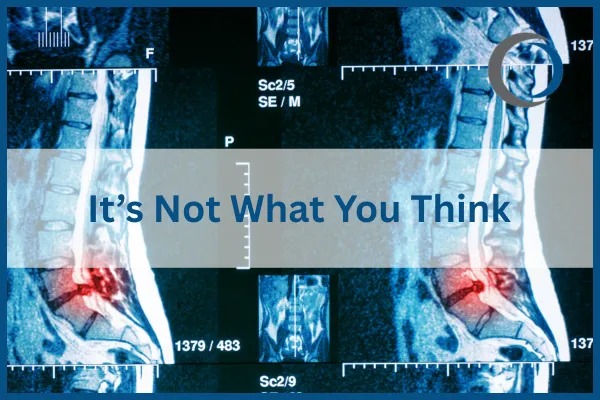
More than 97% of people who walk into our studio have imaging that shows herniated discs, nerve impingements, or both. These are not borderline findings. These are clear, documented structural abnormalities that specialists have pointed to as the source of the problem.
And yet by the time we finish working with them, they no longer have pain.
Think about what that means.
The herniation is still there. The impingement is still on the imaging. Nothing physically pushed that disc back in. Nothing surgically corrected the nerve, and yet the pain is gone.
This happens consistently, not occasionally, not in rare cases, but as the norm. It reveals something profound about the nature of chronic back pain: the structural finding and the pain signal are often two separate things.
The disc herniation exists. But it wasn't what was generating the pain. Something else was. And that something else is systemic and neurological.
What Systemic Neural Entrapment Actually Means
The term for what most chronic back pain sufferers are actually dealing with is systemic neural entrapment.
Not a nerve being physically compressed by a disc. But a nervous system that has become entrapped in a pattern, a loop of threat perception, a protective response, and pain generation that has taken on a life of its own, independent of the original structural cause.
Here is how it develops:
Something happens, an injury, a period of chronic stress, a pattern of movement, an emotional event. Your nervous system responds appropriately by generating pain and protection. That's its job.
But then the original cause resolves or never was what it appeared to be, and the nervous system doesn't get the update. It keeps running the same protective loop. It keeps perceiving a threat. It keeps generating pain. Not because the disc is pressing on the nerve. But because the brain and nervous system are stuck running this pattern. It has become the default.
This is systemic neural entrapment, and it is what most chronic back pain treatments never address.
Why You Can't Fix This With a Physical Intervention
Here is the truth about physical interventions for structurally based pain.
You cannot manually push a herniation back in. You cannot physically change most nerve impingements through hands-on treatment alone. Surgery can alter structure, but surgery on a nervous system running a systemic threat pattern doesn't change the pattern. It changes the structure, and the pattern keeps running.
This is why so many people have back surgery and still have pain. The surgeon fixed what was visible on the scan. But the systemic neurological driver, the pattern the brain and nervous system were running, was never addressed. So it kept generating the same pain signal through a different pathway.
Physical interventions work on physical problems. Systemic neurological problems require a systemic neurological solution.
How We Address the Systemic Neurological Driver
When someone comes to us through the Suffering to Unstoppable system, we start where the problem actually lives, the nervous system.
The first step is providing the brain and nervous system with what they are missing: clarity, prediction, and support.
Your nervous system generates pain when it perceives a threat and doesn't know what's coming next. It stays in protection mode when it feels unsupported and unclear about what is happening in your body. The first layer of work is peeling back that uncertainty, giving the nervous system the information and the felt safety it needs to begin releasing its protective grip.
When this happens, something measurable occurs: range of motion increases, and pain decreases without any physical manipulation of the structure that was blamed on imaging.
This is not theoretical. This is what happens consistently when the systemic neurological driver is addressed first.
The second step is reinforcement.
Once the nervous system has been given clarity and has begun to release its protective pattern, we activate the physical structures around it. Intentional, progressive movement that gives the brain direct evidence, through lived experience, that it can perform movement without pain.
This is critical.
The brain learns through evidence.
It doesn't respond to reassurance alone.
It needs to experience, repeatedly and consistently, that movement is safe.
That the structures are supported.
That the old threat is no longer present.
Each repetition of pain-free movement is a data point the brain uses to update its pattern. And as the evidence accumulates, the old pattern fades. The new one is built around safety, capacity, and freedom. Then it takes its place.
What This Means for Your Chronic Back Pain
If you have been told your pain is caused by a herniated disc or a nerve impingement and treatment of that structure hasn't given you lasting relief, this is what it likely means:
The structural issues are real. The finding on imaging is real. But it is not the primary driver of your pain.
The primary driver is systemic. It lives in what your brain and nervous system are perceiving, processing, and responding to. And it cannot be resolved by pushing harder on the physical structure.
It can be resolved by going to where the problem actually is, the nervous system, and providing it with the clarity, prediction, and support it needs to stop perceiving your back as a threat.
When that happens, the pain that has followed you through every scan, every treatment, and every diagnosis begins to resolve. Not because the herniation disappeared. But because the system driving the pain signal finally received what it needed.
Frequently Asked Questions
Q: If my herniated disc isn't causing my pain, why does it show up on the MRI?
Structural findings like disc herniations are extremely common; research shows they appear in large percentages of people with no pain at all. The findings on imaging tell you something about the structure of your spine. It does not tell you what is generating your pain signal. Those are two different questions.
Q: Can nerve impingement pain go away without surgery?
Yes, consistently, when the systemic neurological driver is addressed. The nerve impingement may remain on imaging, but when the brain and nervous system stop perceiving it as a threat and stop running the protective pain pattern, the pain resolves. Surgery addresses the structure. Systemic neurological work addresses the pattern.
Q: How do I know if my pain is structural or systemic neurological?
Key indicators of systemic neurological pain include: pain that persists long after an injury should have healed, pain that fluctuates with stress or emotional state, pain that doesn't correlate with activity or movement in predictable ways, and most tellingly, structural findings on imaging that don't match the severity or location of your pain. If any of these sound familiar, the systemic neurological driver is likely at work.
Q: How long does it take to address systemic neural entrapment?
Most people begin experiencing measurable increases in range of motion and decreases in pain within the first 1-3 sessions of our Suffering to Unstoppable system work. Full resolution, where the old pattern is no longer reasserting itself, and the brain has accumulated sufficient evidence of safe movement, typically develops over three to six months of consistent, progressive work.
Q: Is this approach available for people who have already had back surgery?
Yes. Post-surgical chronic pain is one of the clearest examples of systemic neural entrapment; the structure was addressed, but the nervous system pattern was not. The same approach applies: address the systemic neurological driver, provide clarity and support to the brain and nervous system, and reinforce with progressive pain-free movement.
The Time to Make a Change Is Now
Your herniated disc is on the image. Your nerve impingement is in the report.
But neither of them is the reason you are still in pain.
The reason you are still in pain is that the systemic neurological driver, the pattern your brain and nervous system have been running.
It has never been addressed.
Every treatment you have received has worked around it, on top of it, or despite it. None of them went to where the problem actually lives.
That is the work we do. And it is available to you virtually or in person.
Schedule your Pain Profile Analysis Call >>HERE<< to gain more clarity on what is causing your pain and the steps to eliminate it.


